A small bedroom does not require a new house, just a few strategic changes.
A handful of adjustments can transform a cramped room into a space that feels open and airy, without adjusting the square footage.
The following techniques, drawn from real-world bedroom makeovers, show how to make a small bedroom look and feel considerably bigger.
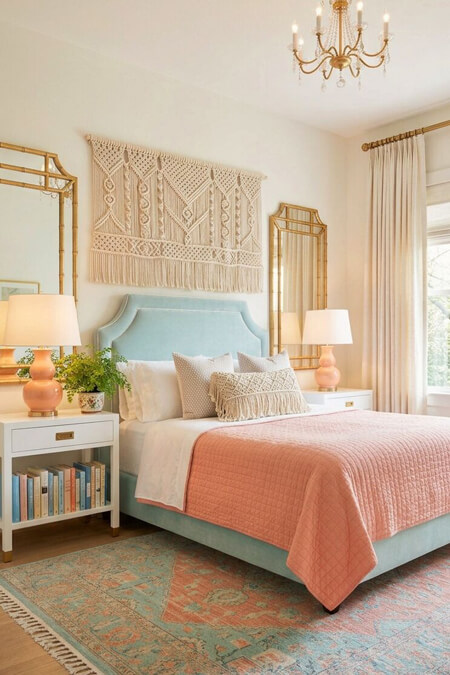 Peach and blue contemporary boho bedroom - AI-assisted image | Human-editedDeclutter First
Designers know that clutter of any kind makes a room feel smaller, so do your best to banish clutter fro your bedroom. Clear out extra paperwork, small tchotchkes, boxes stacked in corners, and easel-style picture frames. A smaller number of larger items reads as more spacious than a large number of small ones.
Instead of easel frames scattered across a dresser, wall-mount a curated selection of the most meaningful photos. This alone removes visual noise without sacrificing personality.
Every home needs a landing zone for everyday items like your purse, keys, phone, and coat. Without one, those items pile up on the nearest flat surface and undercut every other effort to make the room feel bigger by creating clutter.
Make sure to hide dirty laundry and put clean laundry away promptly.
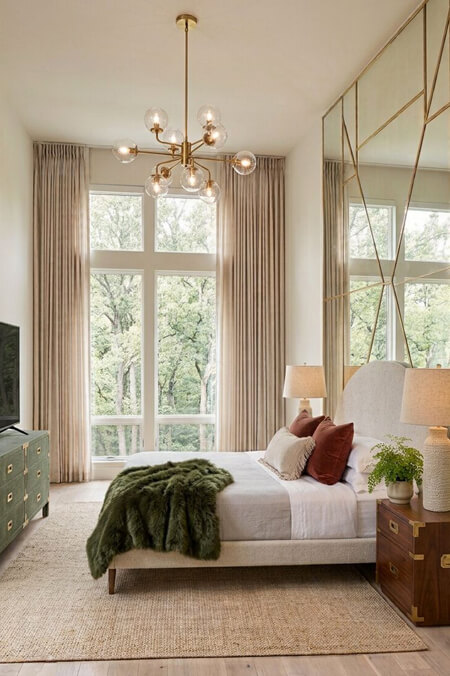 Modern neutral bedroom with green accent - AI-assisted image | Human-editedChoose a Lower Profile Bed
Everyone wants a large bed, but height matters more than most people realize. Tall mattresses are trending, yet they close the gap between the bed and the ceiling, which shrinks the room visually.
Half-height box springs solve this problem by bringing your bed down to a more reasonable level. Four-poster beds and canopy beds create a similar issue: they act as a visual cage that makes the room feel smaller, even when the bed itself is beautifully made. Flush, wall-mounted headboards without a footboard are the exception, since they do not extend outward like taller beds.
A wall-mounted headboard #ad frees up several inches of floor space along the perimeter of the room, which adds up in a small bedroom.
For anyone currently in a twin bed, a daybed pushed flush against the wall opens up meaningfully more floor space than a freestanding twin frame.
In especially tight quarters, a loft bed #ad works well. It functions like a bunk bed with only the top bunk in use, leaving the entire footprint below open for a desk, seating, or storage.
A murphy bed #ad is another option worth considering. It folds flat into the wall when not in use, which returns the full floor space to the room during the day.
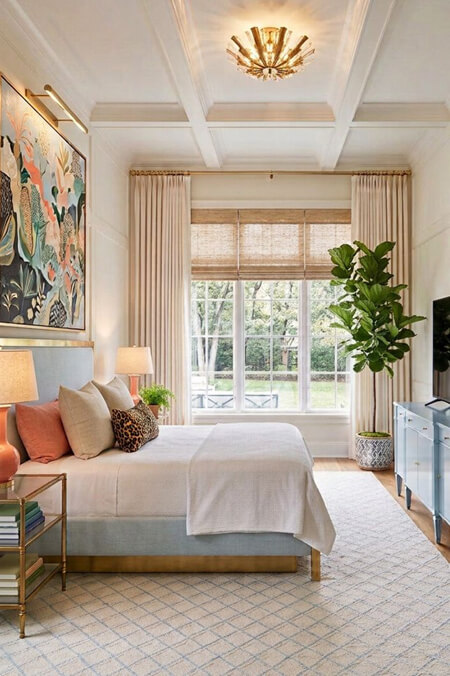 Light blue and white bedroom - AI-assisted image | Human-editedRethink Your Entertainment Center
Matching bedroom furniture sets often include a deep, bulky entertainment center built for an old-style television. That entertainment center has a lot of visual weight, meaning it appears really heavy and feels overbearing in a small room. Relocating an entertainment center to another room and repurposing it for storage elsewhere frees up a surprising amount of space.
A wall-mounted TV paired with a low, shallow media console accomplishes the same function in a fraction of the footprint.
For entertainment centers with a stacked top and bottom section, removing the top portion alone can open up the room considerably while keeping some storage intact.
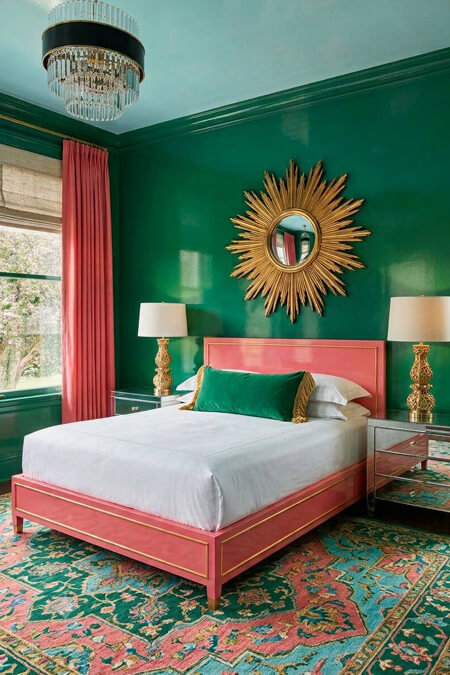 Bold green and pink bedroom - AI-assisted image | Human-editedSelect Flooring and Rugs Carefully
Flooring and rug choices matter more in a small bedroom than a large one. A bold pattern on the floor draws the eye downward and emphasizes exactly how little floor space is available, so a rug with little or no pattern is the safer choice.
Furniture with visible legs, rather than pieces that extend flush to the floor, allows a sliver of flooring to remain visible underneath. That visible flooring reads as more square footage than the room actually has.
Wall-mounted furniture, such as floating nightstands, takes this principle a step further by removing floor contact entirely, which makes the room feel noticeably more open.
A common mistake in bedrooms is having a rug that is too small and makes your furniture look too big for the room, so make sure your rug is sized properly.
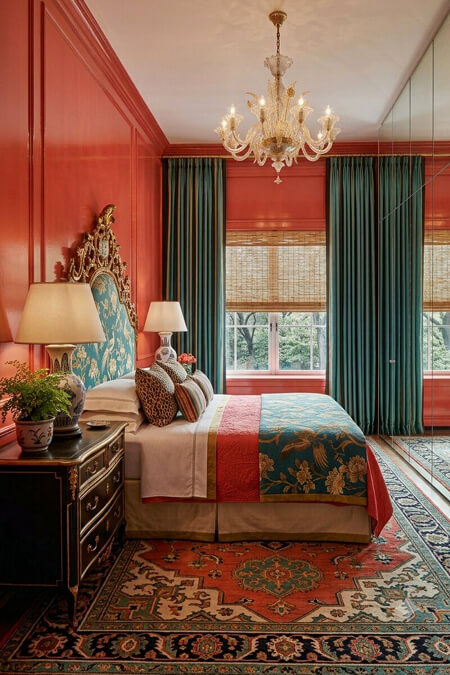 Bold red modernized traditional bedroom - AI-assisted image | Human-editedUse Multi-Functional Furniture
Multi-functional furniture delivers the utility of two pieces of furniture in the footprint of one, which is exactly what a small bedroom needs to free up extra space.
A dresser positioned next to the bed can double as a nightstand, eliminating the need for a separate piece entirely. A mirror mounted above a desk turns that desk into a vanity table as well, without adding a single extra square foot.
A platform bed #ad with built-in storage drawers replaces the need for a separate bed and dresser altogether, which is one of the most efficient trades available in a small room.
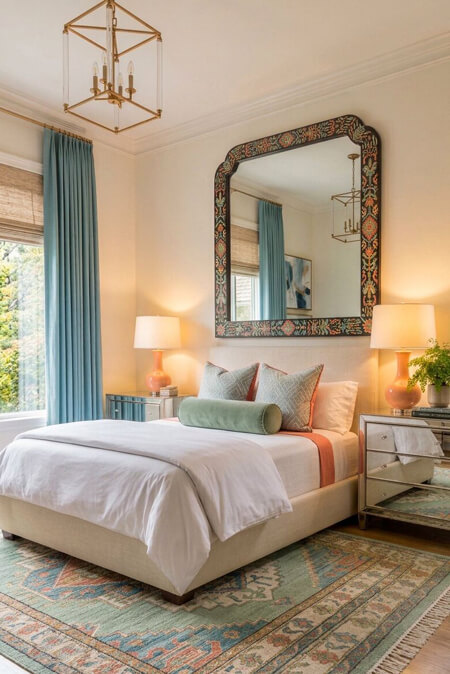 Soft green and blue bedroom with large hand painted mirror - AI-assisted image | Human-editedSimplify Your Bedding
Bright, heavily patterned bedding, especially large-scale florals, draws attention and makes a room feel busier than it is. Solid colors or small-scale geometric patterns in light tones brighten the space and make it feel larger. White sheets remain a classic choice for good reason.
Bed skirts that conceal the flooring underneath work against the goal here, since they hide exactly the visible floor space that helps a room feel bigger (the exception is a bed skirt used specifically to hide unsightly under-bed storage bins).
Color and personality still have a place. Just a few textured or patterned throw pillows and blankets add warmth without overwhelming the room the way patterned bedding does.
You don't need an excess of decorative pillows that end up cluttering your room when you are in bed.
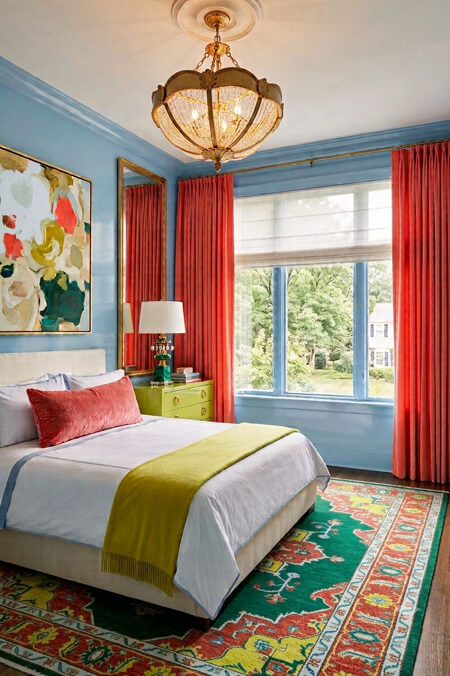 Bold colorful modern bedroom - AI-assisted image | Human-editedMaximize Natural and Artificial Light
A dark room reads as a small room, so light deserves real attention. Heavy, thick-material curtains block daylight and should be replaced with thinner window coverings like lighter weight curtains and/or shades that take up less visual and physical space.
Sheer curtains offer a middle ground: they preserve privacy and disguise an unattractive view while still letting daylight through. Curtains that are not sheer work best kept open as much as possible during the day to let in more light.
Layered lighting outperforms a single overhead fixture every time. Lamps and wall sconces spread light more evenly around the room, and putting all fixtures on dimmer switches with dimmable light bulbs allows the light level to shift with the time of day. Matching color temperature across every bulb (this is listed on the packaging) keeps the lighting from feeling mismatched or off.
A skylight or solar tube #ad is worth considering for rooms that need a more dramatic light boost.
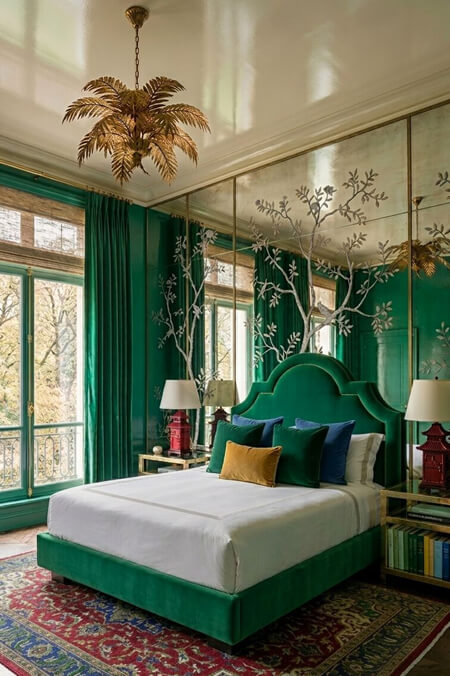 Green bedroom with a mirror wall - AI-assisted image | Human-editedUse Mirors to Reflect Light
Mirrors reflect light and create the illusion that a room continues beyond its actual walls, which makes them one of the most effective tools for making a small bedroom feel bigger. One or two larger mirrors accomplish more than several small ones scattered around the room.
Mirrored furniture extends this effect by bouncing light around the space in a way that solid furniture cannot.
Clear furniture, such as Lucite or hard acrylic pieces, achieves a similar result by allowing light to pass through rather than reflecting it. The one caveat: clear furniture should read as intentional and high-end, not like an outdoor piece or an inflatable pool lounger.
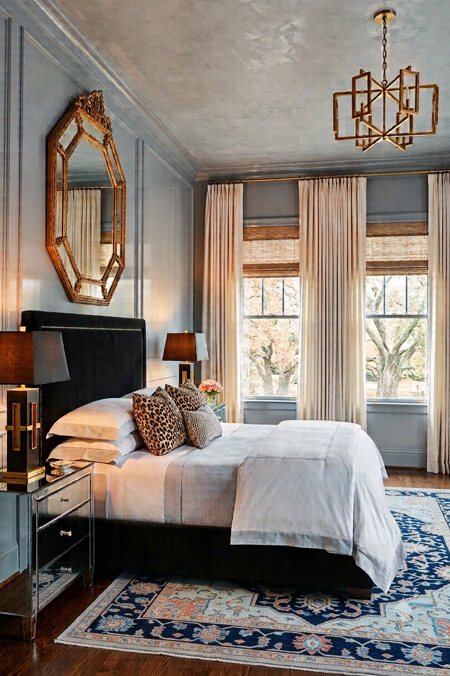 Dramatic black and gray bedroom - AI-assisted image | Human-editedDraw the Eye Upward
Directing attention toward the ceiling makes a room feel taller and, by extension, bigger. In rooms with ceilings above 8 feet, a statement light fixture, a ceiling medallion, crown molding, or a fresh coat of paint in a color other than white all draw the eye up effectively.
A storage cabinet that reaches all the way to the ceiling puts otherwise wasted vertical space to work.
Curtain placement plays into this principle as well. Mounting your curtain rod close to the ceiling makes the windows themselves appear taller. Hanging the curtains so the panels overlap the wall, rather than the window, and barely cover the glass when fully open, makes the windows look wider than they are. For a properly proportioned look, curtain panel width should run 2 to 3 times the width of the window itself (a 75-inch window calls for two panels, one on each side of the window, each measuring roughly 75 inches wide or wider).
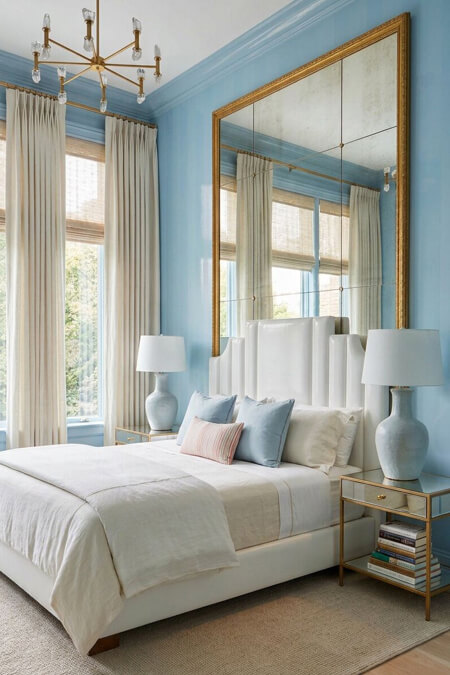 Blue and white bedroom with a huge mirror - AI-assisted image | Human-editedChoose Lighter Colors
Dark, rich colors, especially on the walls, can shrink a room visually. Lighter and brighter colors do the opposite, particularly when it comes to wall color.
Soft pastels and a mix of light neutrals both work well as a base. Personality still belongs in the room, so a few well-chosen accent colors can keep an all-neutral palette from feeling flat.
An entirely white or neutral bedroom can feel remarkably spacious when done well. (For more on that approach, see How to Decorate with Neutral Colors and Not Look Boring.)
One color to avoid regardless of the rest of the palette is a dark ceiling, which makes any bedroom, large or small, feel shorter than it actually is.
None of these changes require a major renovation budget or a bigger house. Just a shift in furniture, light, and a few well-placed mirrors, and a small bedroom starts living much larger than its square footage suggests.