**Make sure to see the video at the end of this article for over 150 British colonial style decorating images.
Have you ever walked into a room that has a lazy ceiling fan turning overhead, white linen curtains catching a breeze, and dark mahogany furniture that looks like it's traveled the world, then felt instantly relaxed? If so, that's the magic of British colonial style. It's one of the most requested looks for homeowners who want their space to feel worldly, collected, relaxed, and a little bit adventurous.
British colonial style decorating was created when British citizens went to live in Africa, India, Asia, and the Caribbean in the late 1800's. They adapted their refined British interior design style to the climate and available materials where they moved, blending formal European furnishings with the practical needs of a hot, humid environment. The result was a hybrid look built for comfort as much as appearance.
British colonial style blends European influences with tropical style, which is perfect for you if you want your home to feel classic yet relaxed. It also happens to be one of the more forgiving styles to work into an existing home, since it leans on furniture shapes and materials you can source at almost any price point. Below, you'll find the architectural cues, materials, colors, and styling rules that define the look, along with the mistakes to avoid.
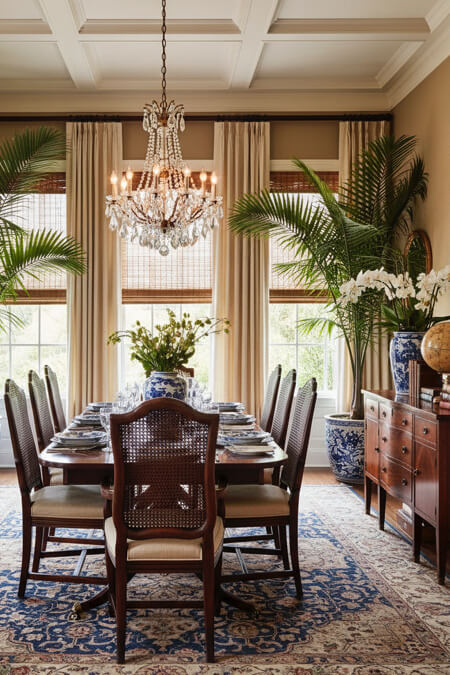 British colonial blue and white dining room - AI-assisted image | Human-editedArchitecture
Homes in a British colonial style typically have high ceilings, often 10 to 12 feet, to let heat rise and keep the room a bit cooler. These lofty ceilings give rooms a grand, airy feeling that's hard to fake with a standard 8-foot ceiling, so if you're working with a lower ceiling, you can borrow the effect with vertical elements instead (tall drapery panels, floor-to-ceiling shutters, or an oversized armoire) to trick the eye upward.
Oversized ceiling fans are also used to keep rooms cool. Look for fan blades in the 52 to 60 inch range with a wood or woven finish rather than brushed nickel or matte black, which will read more modern than colonial.
The ceilings are often made of wood, and floors are made of wood or stone. Walls are usually painted solid white, plastered, or left as stained wood, which keeps the palette calm enough for the furniture and accessories to add interest.
Windows are used to let in light and a breeze. Opening windows on opposite sides of the home creates cross ventilation to keep the home cool, a detail that's more than decorative history, it's a genuinely useful principle if you're designing a sunroom or three-season porch today.
Shutters on the windows help control light and protect the windows in extreme weather. Some more elegant rooms have curtains and perhaps bamboo blinds in addition to curtains, layered so you can adjust for both privacy and light throughout the day.
British colonial style homes typically have wide verandas and porches to easily transition between indoor and outdoor living. The porches provide extra protection from the sun and rain, and if you have the square footage, furnishing a porch with the same quality items and thoughtful design as an interior room instantly elevates it from an afterthought to a destination.
Homes often have a more open floor plan for an expansive yet relaxed feel, and you'll frequently see columns and moldings that provide a more formal, sophisticated feel to balance out the casualness of the tropical materials.
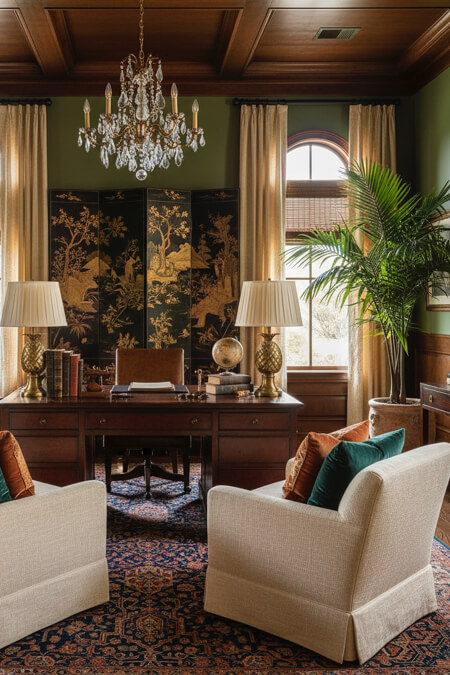 Olive green British colonial home office with Asian screen - AI-assisted image | Human-editedMaterials
The materials used in the architecture of British colonial homes, as well as their furnishings, are often locally sourced, so the exact materials depend on where the home is located. This is a detail worth paying attention to, because it's the reason British colonial style never feels like a matched set from a single catalog. It's meant to look gathered over time and across continents.
Teak, mahogany, rosewood, and ebony are popular woods due to their richness and durability. If you're shopping for a statement piece, a mahogany campaign dresser or a teak console table is a smart place to spend your budget, since these woods age beautifully and hold up to humidity far better than a soft wood like pine.
Cane and rattan are often used for furniture since they're lightweight and allow breathability. Bamboo is very fast growing and plentiful, which made it an economical choice historically and still makes it one today.
Stone and marble are popular choices for floors and countertops. Antique brass, oxidized bronze, antique silver, and aged iron are popular metal choices since they feel a bit older and collected.
Linen, cotton, muslin, silk, and other natural fibers are popular. Pro designer tip - avoid synthetic fibers like polyester, both for authenticity and because natural fibers simply breathe better in a warm climate.
Exotic materials used as accents in the British colonial style include mother of pearl, bone, horn, shell, and coral. A little goes a long way here, one inlaid box or a single horn-handled item reads as intentional, while a room full of them starts to feel like a souvenir shop.
Colors
The most popular colors in the British colonial style are dark stained wood and white. Cream, dark brown, dark green, navy, and muted yellow are also popular, and you'll often see these colors paired so that a dark wood anchors the room while white or cream keeps it feeling light and airy rather than heavy.
Some British colonial style rooms use soft blue, coral, warm gray, and lighter wood colors, though these are less traditional. If you're nervous about committing to a dark, saturated palette, these softer tones are a safe entry point that still nods to the style without fully committing.
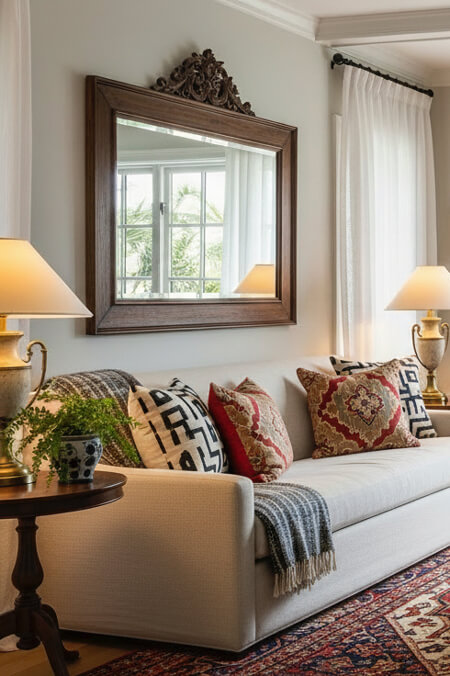 Casual British colonial living room - AI-assisted image | Human-editedPrints
Large scale palm leaf print is very popular in tropical homes. These prints can be used on textiles or on wallpaper, and a single accent wall or a set of pillows is usually enough to make the statement without overwhelming the room.
A small amount of leopard or tiger print can be used as an accent, but don't go overboard, or your living room will start to feel like a safari lodge instead of a colonial home. Stripes are a classic touch in moderation, and ikat, batik, and block prints are popular as well. The specific print you choose can depend on where your home is located or where you've traveled, which is part of what makes this style feel personal rather than purchased off a showroom floor.
Avoid cliche tropical prints, such as a pillow with a palm tree screen-printed dead center. It reads as a beach souvenir rather than an heirloom textile, and it's one of the fastest ways to date and cheapen a room.
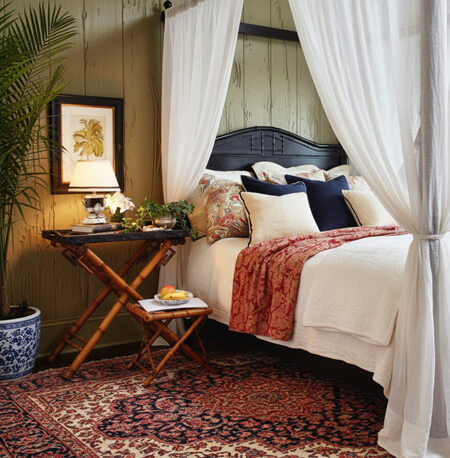 British colonial bedroom with mosquito netting - AI-assisted image | Human-editedFurniture
British expatriates in the late 1800's liked formal furniture in dark mahogany wood that withstands humid climates, which is why it's still so popular in the British colonial style today.
Campaign furniture style is very popular in the British colonial style since it's easily disassembled, packed, and moved. Look for the signature brass corner hardware and recessed campaign pulls, they're an easy way to identify an authentic piece (or a well-made reproduction) when you're shopping secondhand or at an estate sale.
Local materials, such as bamboo, wicker, and rattan, are also popular due to being lightweight. Upholstery is often solid white in color, but sometimes has a pattern such as a botanical print or a simple stripe.
Steamer trunks and suitcases are sometimes used as furniture in the British colonial style, doubling as a coffee table or extra storage at the foot of a bed. Plantation chairs with rattan are popular due to the rattan's breathability, and armoires and wardrobes provide an elegant storage solution in bedrooms that don't have a walk-in closet.
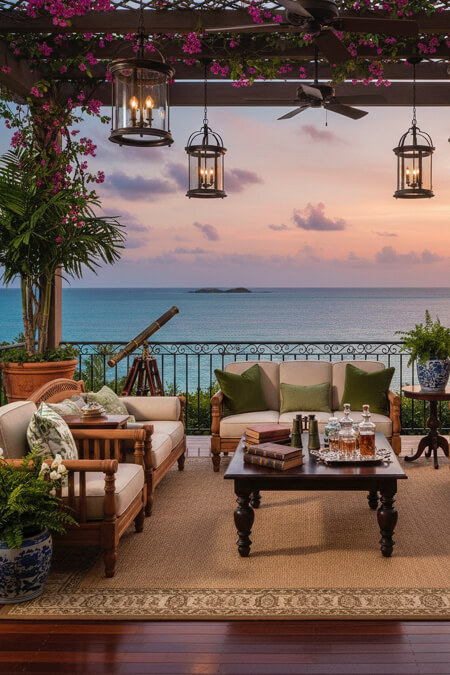 British colonial outdoor patio - AI-assisted image | Human-editedFabrics
Many fabrics in a British colonial home are solid white linen or cotton, which keeps the palette calm enough to let the furniture and architecture stand out. A small amount of botanical prints and animal prints are sometimes used for variety.
Avoid using prints with jungle animals that can look juvenile, such as monkeys, elephants, and giraffes, unless you're decorating a nursery, where that playfulness actually works in your favor.
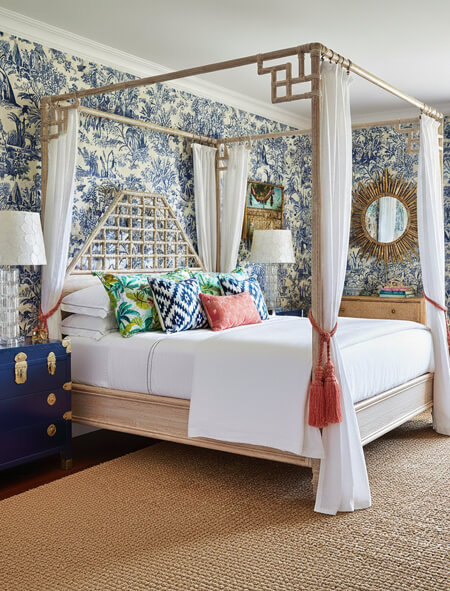
Rugs are often a natural colored jute, sisal, or sea grass, though sometimes a locally purchased oriental rug is layered in for warmth and pattern. In bedrooms, you'll often see a canopy or four poster mahogany bed surrounded by solid white mosquito netting, which today reads as romantic rather than functional, but it's worth keeping for the atmosphere it adds.
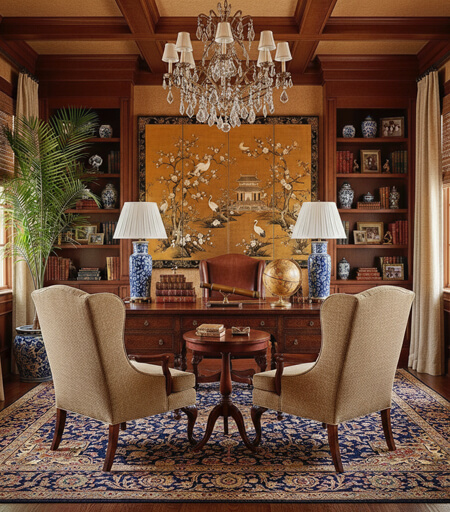 Traditional British colonial home office - AI-assisted image | Human-editedLighting
In order to have a more elegant home, use multiple sources of light so you can control the light level in each room based on the activity happening there.
Ambient light is the overall light typically coming from your ceiling. Task light is the light you use while performing a task, such as a reading light or a piano light. Decorative light is lighting that looks good whether it's turned on or off, such as a chandelier. Accent lighting is lighting directed toward an item of interest, such as an art light over a painting.
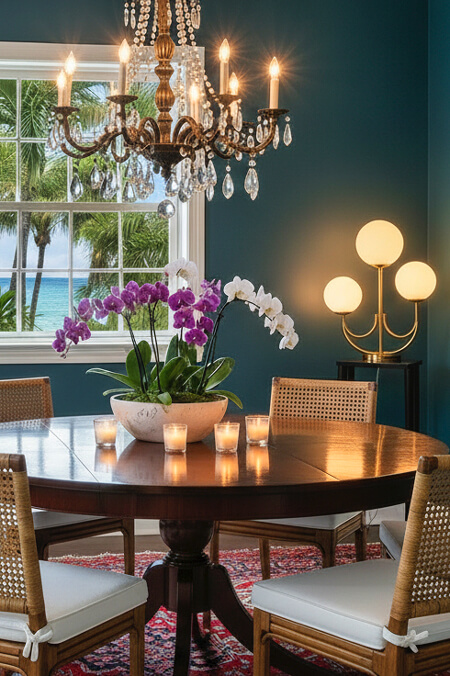
Popular lighting choices in a British colonial home include crystal, woven wood, or brass chandeliers, lantern-shaped pendant lights, porcelain or carved wood table lamps, and wall sconces typically made of metal or wood.
Ceiling fans are extremely popular and can also have a light attached, though most ceiling fans in British colonial homes do not have an integrated light, since the room usually already has plenty of layered lighting from other sources. Pro designer tip - designers typically do not like having an overhead light on because it casts unflattering shadows, so try to add additional light sources to your room so an overhead light is unnecessary.
Candlelight is also a popular choice, whether in a candle holder or a hurricane lamp, and it's an easy, low-cost way to add warmth to a tablescape or mantel.
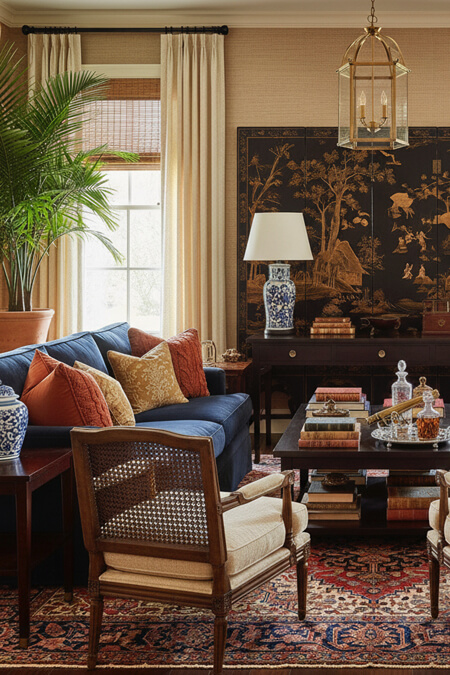 Vibrant British colonial living room - AI-assisted image | Human-editedArtwork
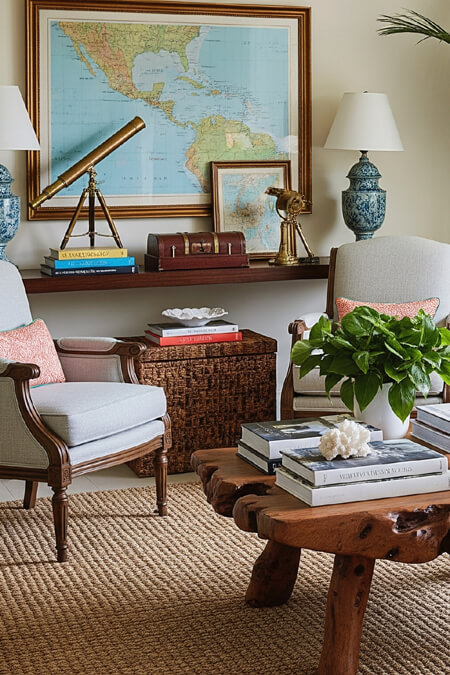
British families at that time were very interested in the study of botany, so botanical prints are often used as artwork, along with old maps that reflect a sense of travel and discovery.
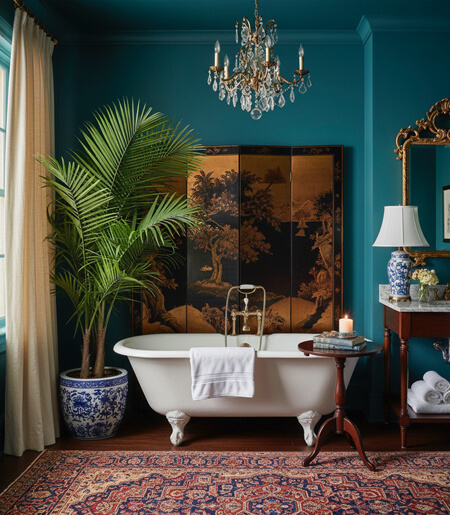
You'll also see mirrors hung on the wall in ornate wood or rattan frames, and items collected from travels, such as Asian screens, hung on the wall as art in their own right.
British colonial homes are often dominated by windows, so minimal artwork is necessary. If you have generous window coverage, resist the urge to fill every remaining wall - one or two meaningful pieces will feel more curated than a gallery wall crammed into leftover space.
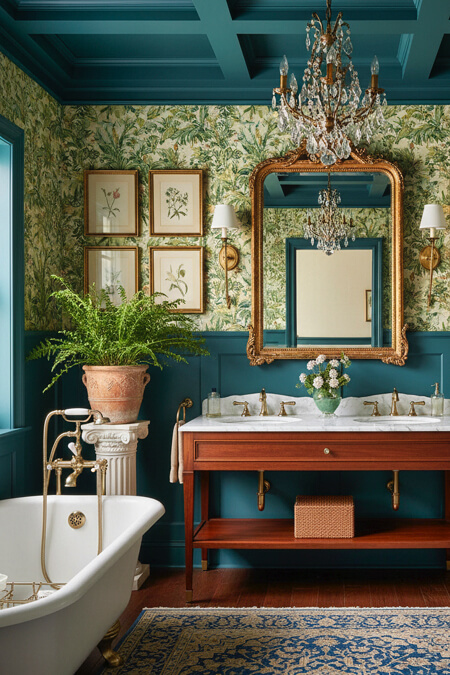 Teal British colonial bathroom - AI-assisted image | Human-editedContrast
One of the professional decorating tricks that interior designers use to make homes look more interesting is to use multiple forms of contrast. Homes without contrast tend to feel basic and boring, even if every individual piece in the room is beautiful on its own.
There are several ways to add contrast to your home. You can use contrasting colors, such as a dark color near a light color, or contrasting textures, using a rough item next to a smooth item, such as rough wicker with a soft cushion. Styles can also contrast, so you might use formal English furniture next to an Asian screen. You can use contrasting shapes, such as a round dining table near a rectangular sideboard, and patterns can contrast as well, such as a striped fabric paired near a floral one. The goal isn't to mismatch on purpose, it's to make sure your eye has somewhere new to land in every direction you look.
 Eclectic British colonial living room - AI-assisted image | Human-editedAccessories
British expatriates were well traveled and liked to show off their quality home furnishings. Displaying globes, fine crystal, fine china, silver items, Asian blue & white chinoiserie porcelain, coral, animal horn, tortoise shells, hurricane lamps, seashells, maps, and telescopes is popular in the British colonial style.
Whether in a bookcase or stacked on a table, books are an excellent accessory because they're functional as well as beautiful. They add warmth and texture to a space. Pro designer tip - consider removing the paper jacket from your books (assuming they are not precious) to let the beautiful spine show instead of the glossy paper cover, which is a small styling trick that instantly makes a shelf look more collected.
Woven baskets or boxes are popular for containing clutter, which matters just as much functionally as it does aesthetically, since this style relies on a sense of order underneath the layered, well-traveled look.
Try not to go overboard with too much pineapple decor. A single well-made piece can be a fun nod to the tropics, but a whole shelf of them tips the room into novelty territory.
 Dark green British colonial dining room - AI-assisted image | Human-editedPlants
Indoor plants are one of the fastest, most affordable ways to bring British colonial style to life, and it's the first thing designers tell clients to invest in when they're working with a tight budget but still want the look to feel authentic. A room full of dark mahogany and white linen can start to feel a little stiff without something living and green to soften it, no matter how well the furniture and architecture are done.
Potted palm trees and potted ferns are extremely popular, and for good reason. A tall potted palm in a woven basket or brass planter works beautifully in a corner that needs height, while a Boston fern or maidenhair fern adds a softer, trailing texture on a plant stand or pedestal. If you have the ceiling height for it, a fiddle leaf fig or a bird of paradise makes a strong architectural statement near a window, standing in almost like a piece of sculpture. Pro designer tip - a single oversized plant does more for a room than three or four small ones scattered around, so if you're only buying one, go big.
Exotic looking flowers, such as orchids, are also popular, and they're an easy way to add a refined touch to a console table, dining table, or bathroom vanity without committing to a large plant. Orchids in particular photograph and read as elegant rather than casual, which fits the more formal side of this style, and they're forgiving enough that you don't need a green thumb to keep them alive for months at a time.
Consider varying the size and placement of your plants throughout a room rather than lining them all up at the same height. A tall floor plant in one corner, a medium plant on a side table, and a small one, like a snake plant or a trailing pothos, tucked on a bookshelf will feel more collected and natural than a matched set. This is the same "one tall, one medium, one short" layering principle designers use when styling a shelf or console, and it applies just as well to greenery.
Also think about your planters, not just the plants themselves. Woven baskets, aged brass urns, ceramic pots in cream or celadon, and even a repurposed ginger jar all work well in this style. Avoid plastic nursery pots left in plain view, and avoid anything overly sleek or modern, like a matte black cylinder, since it will clash with the warm, worn-in materials the rest of the room is built around. A plant is only as elegant as the pot it's sitting in, so don't let a great palm get undercut by a cheap-looking container.
Try to use living plants instead of faux plants since living plants bring a level of texture, movement, and even scent that a faux plant simply can't replicate, and they suit a style that's meant to feel alive and well tended rather than staged. Beyond the look, real plants also do double duty in a humid climate, since many tropical varieties help filter indoor air, which is a nice bonus in a style so closely tied to warm, breezy environments.
If you do not want to have real plants, one faux plant per room is acceptable, as long as it's the highest quality your budget can afford so it doesn't look cheap. Make sure to keep faux plants dusted regularly, or they'll look even more fake than they already do sitting under a layer of dust, which undercuts the whole point of adding them in the first place.
 Modern British colonial bedroom with canopy bed - AI-assisted image | Human-editedModern Interpretations
Modern interpretations of the British colonial style are also very popular, though they aren't historically accurate, and that's perfectly fine. Design styles evolve, and this one has aged well into a more livable, less rigid version of itself.
Modern spaces still include bright white and tropical themes, but they tend to include more brightly painted furniture, more modern accessories, modern art, fewer accessories overall, and more vibrant colors. Traditional British colonial style tends to feel more masculine, while modern interpretations of the style can feel a bit more feminine and less formal.
If you love the bones of this style but want it to feel current, this is your entry point, keep the architecture, materials, and layering principles, and update the color palette and accessories to suit your own taste.
 Teal British colonial bathroom with clawfoot tub and Asian screen - AI-assisted image | Human-editedExtra Tips
When decorating in the British colonial style, hand crafted items are preferred over mass produced ones. Patina and slight imperfections on these items add to their heritage and authenticity, so don't be too quick to sand down or refinish a piece that shows its age.
British colonial style is about having a collected and curated home filled with treasures gathered over the years. Be careful, though, not to include so many items that your home starts to feel cluttered instead of curated, there's a fine line between well-traveled and overstuffed.
This style balances elegance and comfort, so make sure not to decorate with too many fussy, delicate items. At its best, British colonial style should feel like a home you can actually live in, put your feet up on the ottoman, catch the breeze through an open window, and let the room do the rest.
Other Articles You Might Like
How to Decorate in a Sophisticated Beach Style
How to Decorate a Beach House for Christmas
How to Keep Metal From Rusting at the Beach