Do you love your log home's warmth but dread how quickly all that timber starts to feel like one giant brown room? If so, you're not alone.
Log cabin owners face a unique styling challenge: the very material that makes the home feel cozy and authentic can also make it feel dark, heavy, and monochromatic if you're not careful.
The fix isn't ripping out your logs or covering them up - tt's balancing them with the right light, color, texture, and greenery so the wood reads as a feature, not a backdrop that swallows the whole room.
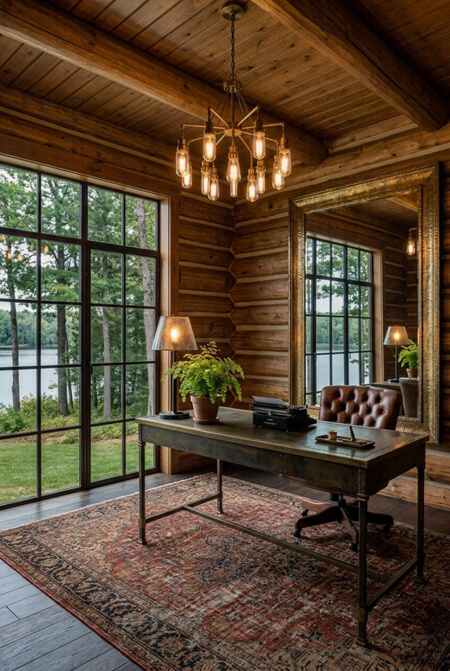 Home office in a log cabin with a large mirror - AI-assisted image | Human-editedLight
Log homes are notorious for feeling dim, especially in the winter months when the sun sits lower in the sky. Dark logs tend to absorb light instead of reflecting it, so a log home often needs 20-30% more lighting than a drywall home of the same square footage to feel equally bright.
Start with the easiest fix: minimize anything covering your windows, inside and out. You can do this by trimming back exterior trees or shrubs blocking your windows and making sure that your curtains are able to be opened all the way to barely overlap your window by only 2 inches.
Next, look at your light fixtures. Swap in bulbs with a higher lumen output (aim for at least 800 lumens per bulb in main living areas and closer to 1,200 in kitchens) and layer your lighting the way professional lighting designers do with ambient overhead light, task lighting where you actually work or read, and accent lighting to highlight art or architectural details. A single overhead fixture almost never solves a log home's light problem on its own.
If your budget allows, consider enlarging an existing window or adding a skylight. Even one 2-foot by 4-foot skylight over a kitchen or stairwell can transform how a log home feels at midday.
Reflective surfaces are your secret weapon in creating more light in a room. A large mirror (36 inches by 48 inches works well over a console table or sofa) bounces both natural and artificial light back into the room. Metallic accessories, glass lamp bases, and polished nickel or brass hardware all do the same job in smaller doses.
Also, don't underestimate flickering light from firelight and candlelight. Both add warmth without adding to all of the brown, and both play beautifully off log walls instead of competing with them.
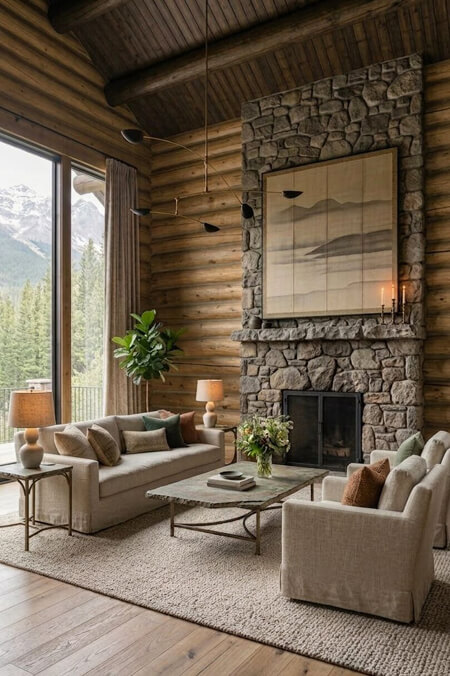 Log cabin living room with light neutral colors - AI-assisted image | Human-editedColor
The single biggest mistake log home owners make is decorating with more brown. Add white and/or brightly colored pieces to break up all that brown from your timbers.
Brown leather furniture is everywhere in log homes, and it's an easy trap. Instead of a brown sofa, consider using a white, cream, or colorful sofa to give your eye somewhere to land besides the walls. If a full color change feels like too much commitment, start smaller. A colorful area rug or a set of brightly colored throw pillows can shift the whole feel of a room for a fraction of the cost of new furniture.
Even something as simple as a bowl of lemons or green apples on your kitchen counter adds a hit of color to what's often the most wood-heavy room in the house.
Colorful wall art or a woven tapestry does double duty - it introduces color and covers a portion of the log wall at the same time.
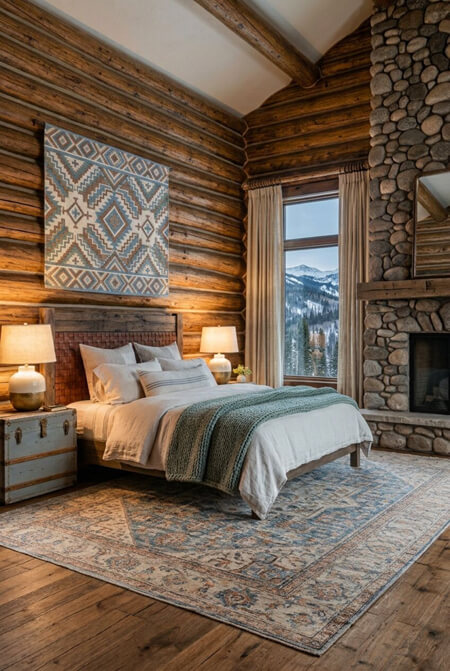 Cozy log cabin bedroom - AI-assisted image | Human-editedFabrics
Log cabins can read as masculine, utilitarian, and a little too rugged to feel truly welcoming. Fabric is how you soften that.
Leather is the default in most log homes, which comes across as very masculine, so consider layering in fabrics you don't typically see in a cabin: linen, velvet, or a soft cotton blend. Colorful curtain panels paired with a soft white sheer underneath adds both color and texture without blocking your hard-won natural light. Just make sure the panels hang about a half inch above the floor. Pro designer tip - puddling fabric in a rustic space tends to look messy rather than luxe, so no curtain puddles.
A fluffy rug underfoot, soft white bedding, and a chunky knit throw all contribute the same effect. Fabric on the walls works too - a quilt or a woven tapestry breaks up the wood and has the added benefit of absorbing sound. Log homes with vaulted ceilings and hard wood surfaces everywhere can get echo-y fast, and soft goods are one of the most effective fixes.
The contrast between rough-hewn logs and soft, tactile fabric is what makes a log home feel curated instead of accidental. Designers call this juxtaposition "hard-soft contrast," and it's one of the fastest ways to make a rustic space feel current and interesting.
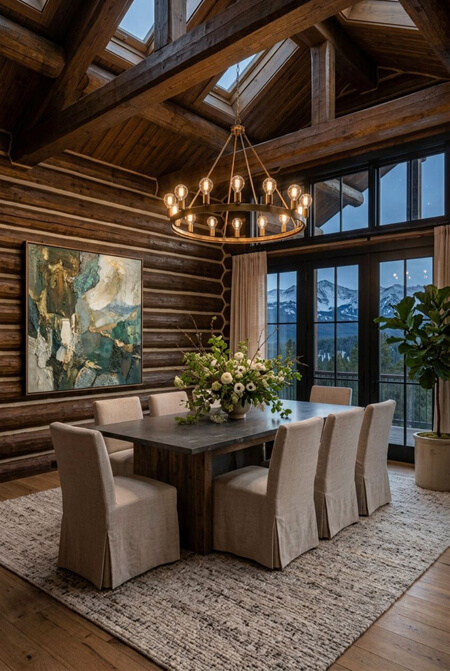 Modern log cabin dining room - AI-assisted image | Human-editedFlowers and Plants
Bringing living greenery indoors is one of the simplest ways to soften a log home, and it's backed by more than aesthetics. Research on biophilic design (the practice of incorporating natural elements into interior spaces) consistently links indoor plants to improved air quality and lower stress levels, which makes them a functional choice as much as a decorative one.
Flowers add a soft, feminine touch that contrasts nicely against heavy timber. The easiest way to keep greenery in rotation is to pick up a bunch every time you're at the grocery store. If you want a more sustainable long-term solution, consider planting a cutting garden. Even a 4-foot by 8-foot raised bed can supply enough seasonal blooms to keep a few vases going through spring, summer, and fall.
When flowers aren't in season, greenery alone does plenty of work. Eucalyptus, olive branches, and magnolia stems all hold up well without water for a week or more, and they're especially valuable in winter when the view outside your windows has gone gray and bare.
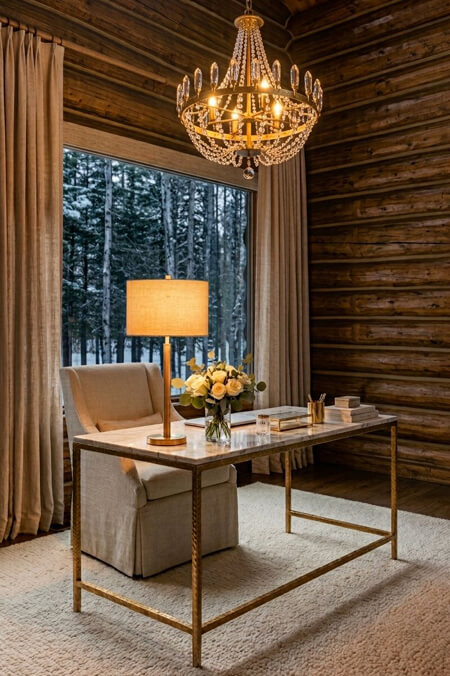 Log cabin home office with crystal chandelier - AI-assisted image | Human-editedModern & Feminine Elements
Don't be afraid to mix in pieces that have nothing to do with rustic style. The tension between rough logs and polished, modern decor is what makes a log home feel designed rather than default.
A sleek modern light fixture, a piece of abstract art, or a crystal chandelier over a dining table reads as unexpected in the best way against raw timber walls. Feminine colors and smooth, refined textures (think polished brass, lacquered furniture, or a curved velvet chair) create a deliberate contrast that makes the whole room feel more intentional.
This is also where your home starts to look like yours instead of a page out of a rustic lodge catalog. Anyone can buy log walls. Not everyone knows how to make them feel personal.