The difference between a bookcase that looks like a design feature and one that looks like a storage problem comes down to a handful of simple design principles.
None of the principles are difficult to implement, however all of them make an enormous difference.
Here is exactly what professional interior designers do to make a bookcase look intentional, curated, and beautiful.
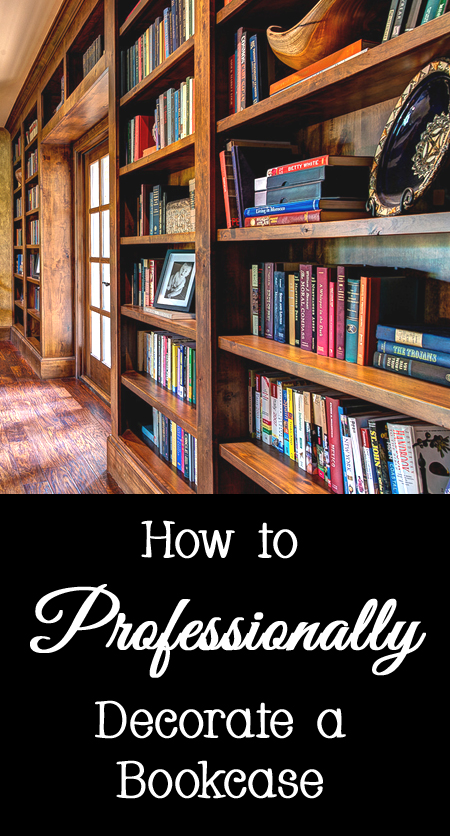 photo courtesy of okchomeseller flickr.com/photos/okchomeseller/8016616654/
Empty the Shelves
When decorating your bookcase, start by removing everything to start fresh.
Make sure to do a deep clean of your bookcase before decorating.
Sort through your items to decide what to keep and what to relocate or donate.
Mostly Books
Since bookcases hold books, the majority of the items on a bookcase should be books, else your bookcase is actually a display cabinet (which is not necessarily a bad thing).
For a library feel, only display books in your bookcase (no accessories).
Display attractive hardback books only. Many bookcases have a lower enclosed portion that can hold lesser attractive paper back books and binders. Another option is to add a few baskets to the bookcase to hold lesser attractive items.
Consider removing the paper jackets from your books to expose their beautiful spines (unless they are collectibles).
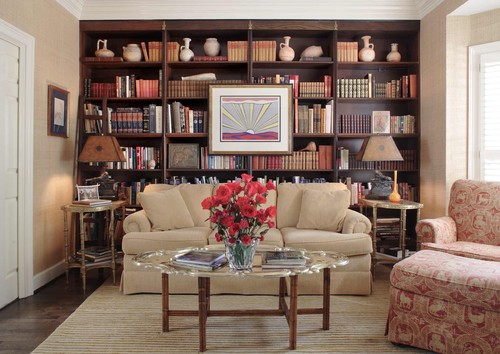
Don't Organize By Color
A bookcase must be functional as well as beautiful.
You can organize your books by type, subject matter, author, or whatever makes sense to you, but do NOT organize your bookcase by color because it looks too contrived and you might have a hard time finding a particular book.
Don't Turn Books Backward
Many TV shows will show books in a bookcase turned backwards with the spine towards the back of the bookcase or recovered in a plain cover without any markings on it due to trademark and copyright issues.
Do NOT do this in real life. You need to be able to locate books.
If you like a clean aesthetic, feel free to recover all of your books in special coverings, but make sure there are markings on the outside to identify the book.
Different Directions
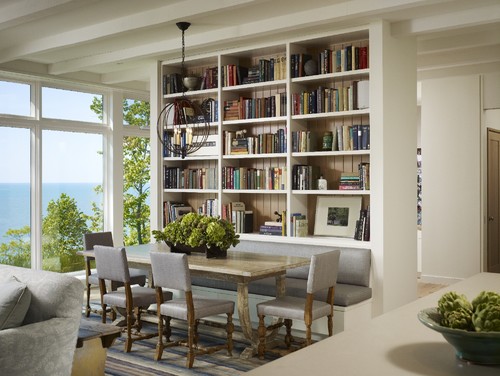
Unless you want your bookcase to look like a library (which is a good solution for some), try arranging your books in various directions.
Some can be upright and pushed to the left of the shelf.
Others can be upright and pushed to the right of the shelf.
Also consider stacking books that you don't read very often horizontally for yet another direction.
You can even have a few smaller books on the ends turned at a diagonal.

Bookends and Decor
If you plan on using decorative bookends, use substantial bookends, not little ones.
A stack of smaller books turned on end works well as bookends. A heavy statue, vase, or clock can also be used as bookends.
If you want to add a bit of decor to your bookcase, then use items of various shapes and sizes.
Select decorative items that are personal to you (your heritage, hobbies, travels, accomplishments, etc) instead of a random basic mass produced item that you found at a local home decor store.
Some people like to decorate bookcases with plants to give an organic feel. If you do this, make sure to use real plants for the best result. Since live plants require light and water, make sure your bookcase is an appropriate environment.
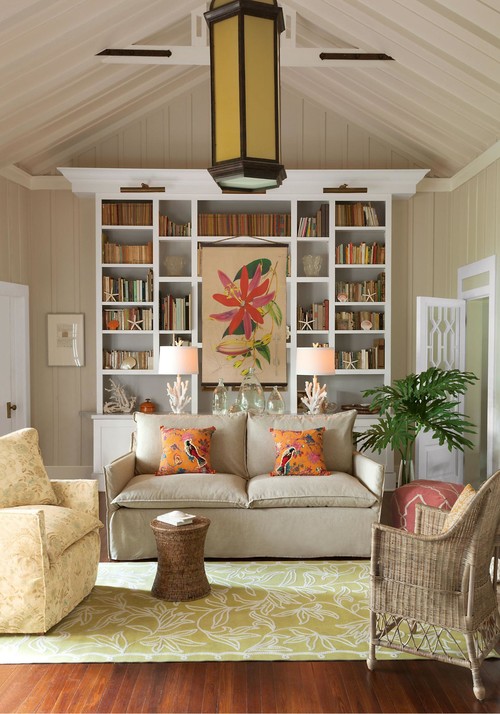
A Little Free Space
Leave about 10% of empty space in your bookcase, if possible.
Bookcases look best with a bit of "breathing room".
A completely filled and decorated bookcase does not allow room for new books.
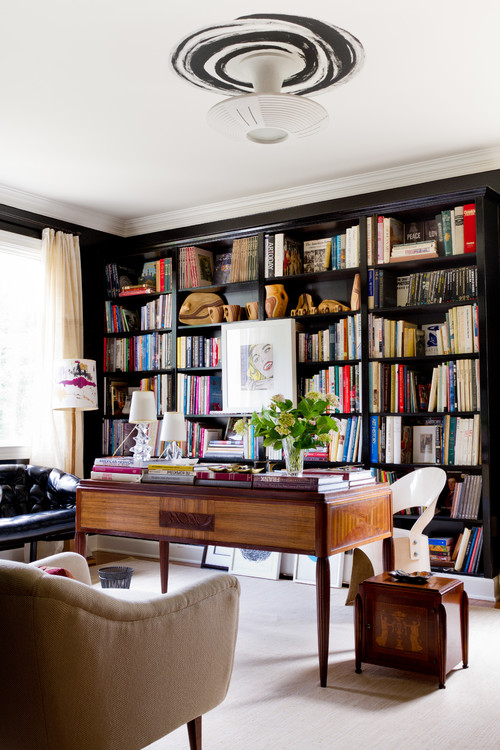
Books as Decor
If you are an avid reader, you might have more books than your bookcase will hold.
Extra books can be used as decor in other places of your room.
You can decorate with them stacked on end tables, you can get more bookcases, or you can start using a wireless reading device instead of buying new books.
You Can Buy Books in Bulk
Books add a lovely texture as well as a variety of colors that create a pleasing aesthetic, so feel free to use attractive books as accessories (even if you don't plan on reading them).
If you have a bookcase that is very bare and you are not a big reader, consider buying hardback books in bulk to complement your decor.
Your local library will usually sell extra copies of books at a very low price, you can buy books at a used book store, or you can get books at garage sales or estate sales.
Remove the paper jackets off the hardback books to see the color of their spine to make sure the color does not conflict with your room's color scheme since the paper jacket and book spine are often very different colors.
Books that are a bit distressed and look like they have been read many times add character and charm to a bookcase.
Vintage and antique books tend to be bound in a fabric cover instead of a leather or faux leather cover. Older fabric covers tend to have a lot of texture and add interest and warmth to a room.
If you have a dark bookcase, a majority of lighter colored books look best since they will contrast against the dark background.
If you have a light bookcase, a majority of darker colored books look best.
Professional stylists swear by odd numbers because they tend to look better than even numbers.
When arranging decorative objects on a shelf, always group them in threes or fives but never twos or fours. Odd-numbered groupings feel collected and intentional. Even numbered groupings feel stiff and symmetrical in a way that reads as amateur.
Approach Each Shelf Individually
The biggest mistake people make when decorating a bookcase is stepping back and looking at the whole unit instead of treating each shelf as its own small vignette.
Keep a Loose Color Story Without Being Too Strict
Organizing books strictly by color is a hard no, but that does not mean color has no role to play on your bookcase.
This is one of the most impactful and least expensive things you can do to elevate a bookcase, and most people have never considered it.
Add Lighting
A bookcase without lighting is a missed opportunity.
Size Your Decor to the Shelf
A shelf full of small, fussy objects is one of the most common bookcase mistakes, and it is an easy fix.
Know What Belongs Elsewhere
A bookcase is not a storage solution for everything that does not have another home.
Other Articles You Might Like......
How to Decorate a Bedroom for a Bibliophile