Every room needs a focal point to look well designed, but most living rooms, bedrooms, and dining rooms don't have one.
The fastest and most affordable solution is also one of the most overlooked: a single large piece of artwork.
Hung correctly, art can give an entire room direction, anchor the furniture around it, and create a color palette for the room.
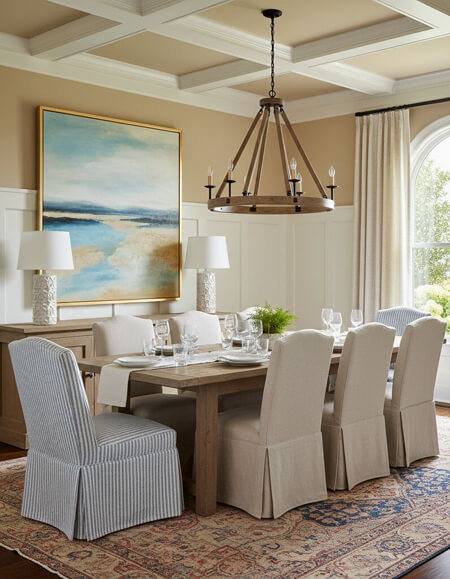 Coastal style dining room - AI-assisted image | Human-editedWhy Artwork Works as a Focal Point
Every well-designed room needs a place for a person's eye to be drawn to first when entering the room. Interior designers call this the focal point of the room, and artwork can be that focal point.
Art can be added to any wall, in any room, at any budget, and it does not require construction. An investment in art can also move to a new home in the future.
A 40" x 60" abstract painting over a sofa, for example, can transform an ordinary living room into one that looks professionally designed, often for less than the cost of a new accent chair.
This is one of the first tricks taught in design school, and it remains one of the most reliable, room after room.
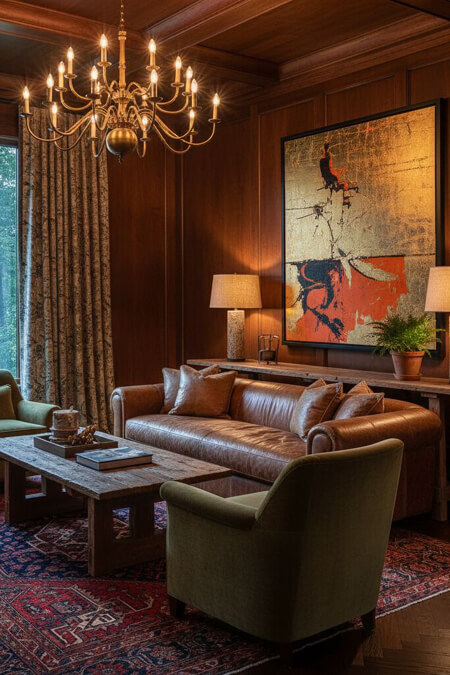 Rustic style living room with brown leather sofa - AI-assisted image | Human-editedChoosing Large-Scale Art for Maximum Impact
When selecting art for a focal point, size matters more than almost anything else. The artwork has to be large enough to be the first thing a person notices when they walk into the room.
Consider this the general rule of thumb: a focal-point piece should cover roughly two-thirds the width of the furniture it hangs above, whether that's a sofa, a bed, or a console table. For a standard 84" long sofa, that works out to a piece or art somewhere around 56" wide at minimum but no wider than the sofa. Anything smaller starts to look like an afterthought rather than a design choice, and it's the single most common mistake seen in DIY attempts at this look: buying art sized for a bedroom nightstand and expecting it to anchor a two-story great room.
Also, resist the urge to fill the wall with a gallery of small pieces instead. A collection of 8x10s and 11x14s scattered across a wall might feel like a budget-friendly option, but it tends to read as cluttered and inexpensive rather than intentional. Not only that, all of those small cheaper pieces can often cost more than one larger piece of art. Save the small-scale gallery walls for hallways or secondary spaces. The focal point wall deserves one strong statement.
A few options work well for this purpose:
- A large-scale painting or canvas print
- An oversized framed poster or print
- A substantial sculptural piece, mounted or freestanding
- Two or three large pieces from the same series, hung together to read as one unit
For the best results, choose artwork with several colors represented rather than a single-tone piece. A painting with only one or two colors does not add to the room's palette. The subject matter should also reflect the homeowner's personal style and personality; a coastal landscape painting will set a very different tone than a bold, graphic abstract painting.
Professional designer tip: hanging heavy artwork correctly is not optional. A large canvas or framed piece that falls off the wall can cause real injury, and it happens more often than people expect, particularly with pieces over 30 lbs. hung on a single nail. Locating wall studs and using the correct hardware for the piece's weight makes all the difference. Learn how to hang heavy items on a wall safely before mounting anything oversized.
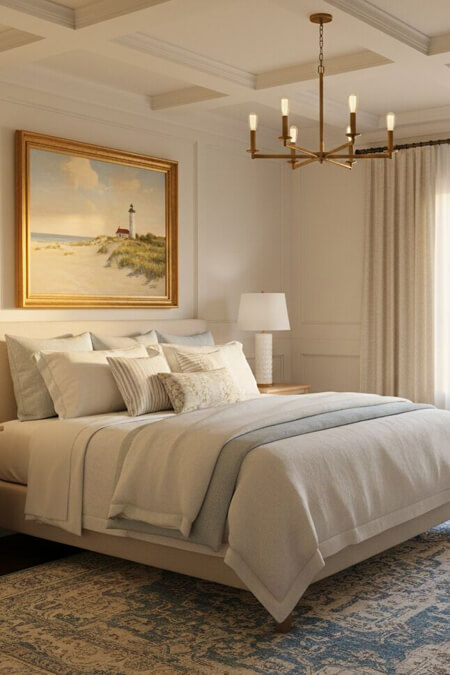 Blue and white cozy calming bedroom - AI-assisted image | Human-editedWhere to Hang Focal-Point Artwork
Placement determines whether that investment in a large piece actually pays off.
In order for artwork to function as a true focal point, it needs a place of prominence, not an out of the way wall.
Strong locations include:
- Over a mantle or fireplace in the living room
- Over a sofa or sectional
- Above an entry table in the foyer
- Over the bed in a bedroom
- Above a server or sideboard in the dining room
Avoid hiding focal point art in a narrow hallway where a person has to turn their head back and forth just to take in the whole piece. Instead, position it at the end of the hallway, where it becomes a destination rather than something to squint at in passing. A piece placed this way also has the added benefit of drawing guests further into the home, and it's a trick used often in client foyers to make an entry feel intentional rather than like a pass through space.
As for height, hang the piece so its center sits at roughly 57" to 60" above the floor, which is standard eye level for most adults. Over a sofa, bed headboard, or any other standard height piece of furniture, use different measurements - leave about 6" to 8" of space between the top of the furniture and the bottom of the frame. Too much air between the two, and the piece reads as disconnected from the furniture below it.
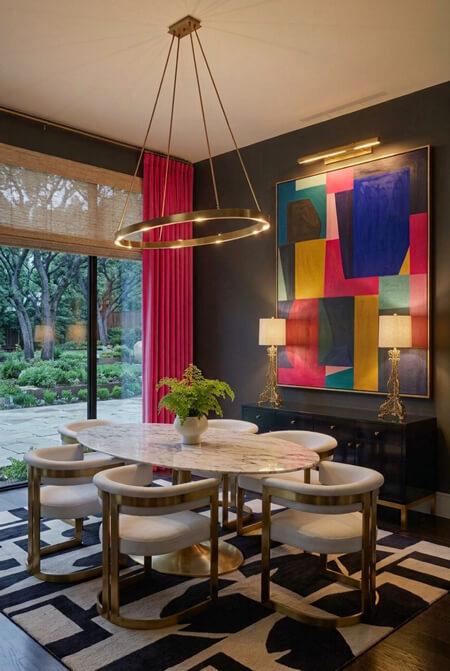 Bold black and white dining room with colorful art - AI-assisted image | Human-editedBuilding a Color Scheme Around Your Artwork
Once the focal point artwork is hung, it becomes the anchor for the entire room's color story. Pull colors directly from the piece when selecting accessories, rather than starting from scratch or relying on trend colors that have nothing to do with the art.
Throw pillows, a folded blanket, candles, an area rug, hand towels, a stack of books, and small figurines are all easy ways to echo the artwork's palette throughout the space. As a general guideline for a colorful room, you can choose at least three colors from the artwork and repeat each one in at least three separate spots around the room. A painting with soft blue, mauve pink, and sage green, for instance, might show up again in a blue ceramic lamp, a mauve throw pillow, and a green vase on the coffee table. Repeating colors this way (rather than using each one only once) is what makes a room feel cohesive instead of scattered. Remember that neutral colors, like black, white, gray, beige, cream, and brown are colors too. If you prefer a less colorful room, you can repeat only one or two bold colors or repeat the neutral colors instead of the bold colors.
For a more professional looking color scheme, don't use all the exact same colors. Instead, use some lighter and darker versions of your colors to create more variety and give a more collected look instead of a "bed in a bag" matching feel.
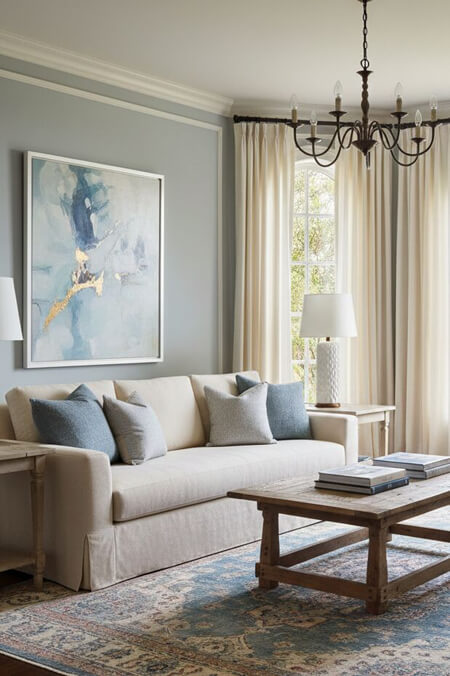 Neutral modern living room - AI-assisted image | Human-editedCommon Mistakes to Avoid
A few missteps show up again and again in rooms that try this approach and fall short:
- Choosing artwork that is too small for the wall or furniture below it, which leaves the space feeling unfinished no matter how well everything else in the room is styled. 2/3 the size of the wall or item below it is ideal, but you might be able to get away with 1/2 to the full width of the wall or item below it. Anything smaller than 1/2 tends to look too small.
- Skipping the color repetition step, which leaves the artwork looking disconnected from the rest of the room rather than tied into it. Aim for cohesion in design where all items work together instead of feeling random.
- Forgetting lighting. A large piece of art in a dim corner loses most of its impact after sunset. A simple picture light mounted above the frame, or an accent lamp nearby, keeps the focal point working around the clock.
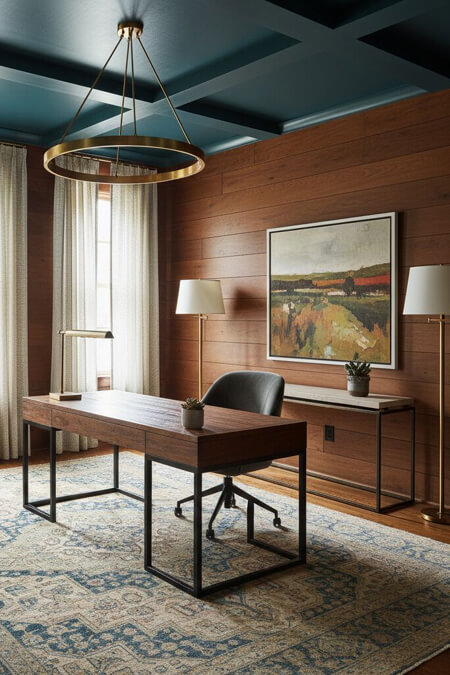 Modern home office with wood paneling - AI-assisted image | Human-editedQuick FAQ
How big should focal point artwork be? As a starting point, aim for a piece that spans about two-thirds the width of the empty wall or furniture beneath it, such as a sofa, bed, or console.
Can I use more than one piece of art as a focal point? Yes. Two or three large pieces from the same series or collection can be hung together and will still read as a single, unified focal point, as long as they are sized and spaced consistently.
What if my artwork doesn't have very many colors? A more monochromatic piece can still work. In that case, build the room's palette around one or two dominant colors plus a neutral, rather than forcing in extra colors the artwork doesn't actually have.
Other articles you might enjoy....
How to Display Children's Art in a More Organized and Sophisticated Manner