Do you need to decorate a baby nursery but don't know the gender? Perhaps you have a baby boy and a girl sharing a room? Do you expect to have more babies down the road who will inherit this same nursery? Maybe you simply prefer a neutral color palette over the traditional pink-or-blue divide?
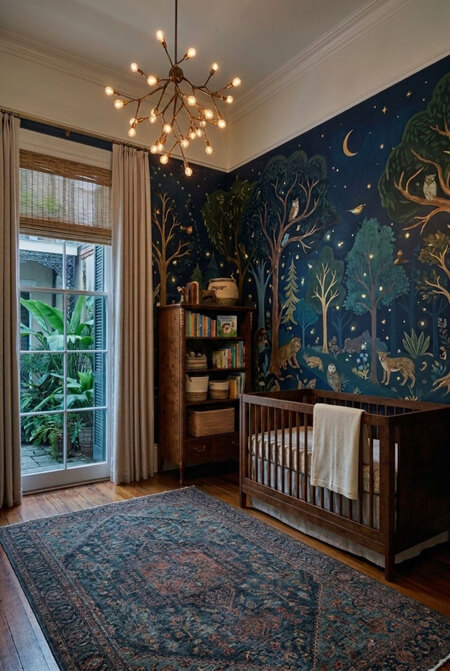 Moody modern baby nursery - AI-assisted image | Human-editedNeutral Furniture
Most nursery furniture comes in either white or a stained wood finish, and both work well in a gender neutral space. Avoid furniture painted pink or blue, and steer clear of anything overly ornate in a feminine style, like a crib with heavy scrollwork or floral carving.
For a more current look, consider furniture in a metallic finish, or a piece in black or a very dark espresso tone. Black nursery furniture has become increasingly popular in the past few years because it reads as sophisticated rather than juvenile, and it pairs easily with almost any color scheme you add around it later.
When you get to upholstery, choose fabric that doesn't skew overtly feminine or masculine. A boucle or a textured linen in a neutral tone works better here than a floral print or a masculine plaid.
It's also worth investing in a convertible crib, one that transitions from a crib to a toddler bed and sometimes a full daybed. Expect to pay $400 to $900 or more for a quality convertible crib, but that investment stretches the furniture's usable life from infancy through the early elementary years, which matters even more if you're not sure how many children will eventually use this room.
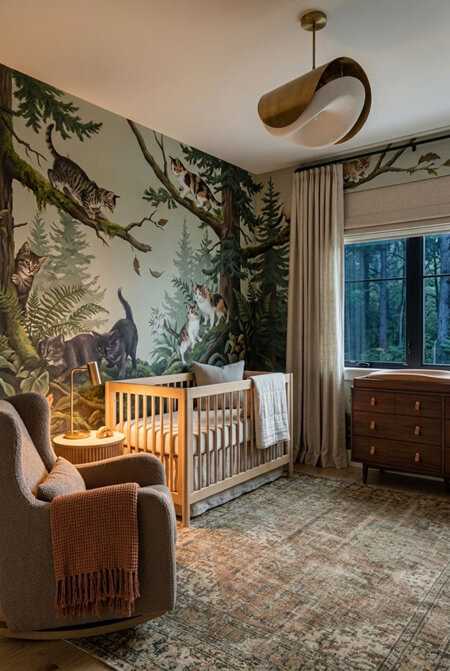 Gender neutral baby nursery with cat theme - AI-assisted image | Human-editedNeutral Theme
You don't need a theme at all in a baby nursery and plenty of well-designed nurseries skip the theme entirely and rely on color and texture instead.
However, if you want a theme, choose something that isn't tied to a specific gender.
Avoid themes built around team sports, flowers, dancing, princesses, butterflies, trucks, hunting, or superheroes, unless you're deliberately including an equal mix of male and female characters. These themes read as gendered almost instantly, even in neutral colors.
Instead, consider nature, hot air balloons, the night sky, birds, pets, colorful geometric shapes, the alphabet, or travel. These themes give you plenty of room to decorate without boxing the space into "boy" or "girl" territory, and most of them age well past the baby years, which means less redecorating for you down the line.
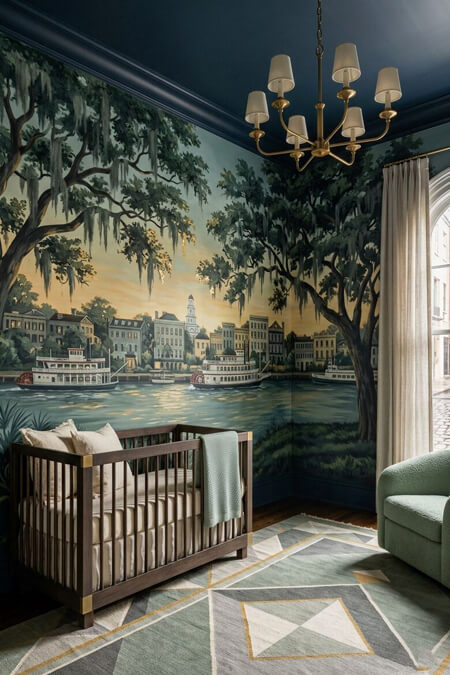 Gender neutral baby nursery with river boat theme - AI-assisted image | Human-editedNeutral Colors
Skip the baby pink and baby blue that immediately signal a specific gender. Instead, reach for gender neutral colors like a pastel yellow or a soft sage green.
Round out your palette with white, black, gray, brown, and beige. If you're drawn to a mix of soft pastels and don't want to give up pink or blue entirely, that's fiine, just use them in equal amounts alongside your other colors so neither one dominates the room.
Pro designer tip - mix your pastel with gray to mute it into something softer and more sophisticated. That's exactly how you land on a color like sage green, which is really just green pulled down with a touch of gray. The same trick works on blush, butter yellow, and dusty lavender.
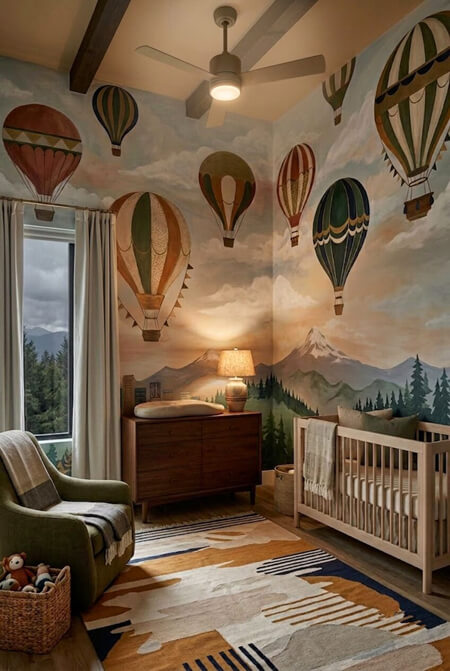 Hot air balloon themed gender neutral nursery - AI-assisted image | Human-editedMixture of Colors
If you want an easier starting point, choose one large item to anchor your palette, like a piece of art or an area rug, and let it dictate the rest of your color choices. Look for a piece that includes at least three colors.
From there, repeat at least three of those colors throughout the room in at least three separate places. This is a foundational technique in professional color theory called the "rule of three," and it's what keeps a room feeling curated instead of scattered. A rug with sage green, mustard, and cream in it, for example, might show up again in a throw pillow, a framed print, and a set of curtain panels.
Pro designer tip - use lighter and darker versions of those same colors too. That range of values is what gives a room depth instead of flatness and makes it look more custom instead of looking like a generic "bed in a bag".
If you're waiting to learn your baby's gender, hold off on the smaller accessories. Wait until after the birth to add anything in a more gender-specific shade, so you're not stuck with items that no longer fit.
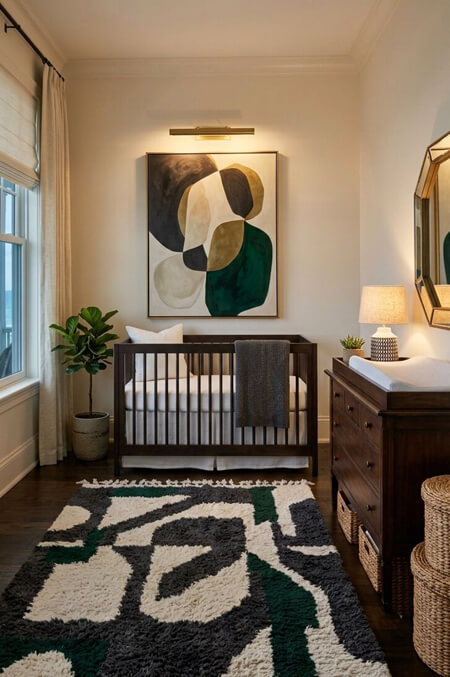 Ultra modern neutral baby nursery - AI-assisted image | Human-editedUnexpected Colors
Instead of the soft pastels that most nurseries default to, consider going bolder. A rich navy reads as far more gender neutral than baby blue. A true, saturated purple feels far less gendered than a pale lavender.
Other colors worth considering: orange, turquoise, teal, emerald green, and burgundy. For a more glamorous nursery, work in metallics like gold, silver, or brass through hardware, light fixtures, or picture frames.
Going almost entirely neutral, heavy on white, black, gray, and beige, with only small pops of color, is unexpected in a nursery. It also tends to look more sophisticated than a room full of pastels, and it photographs beautifully if you're documenting the space for family or on social media.
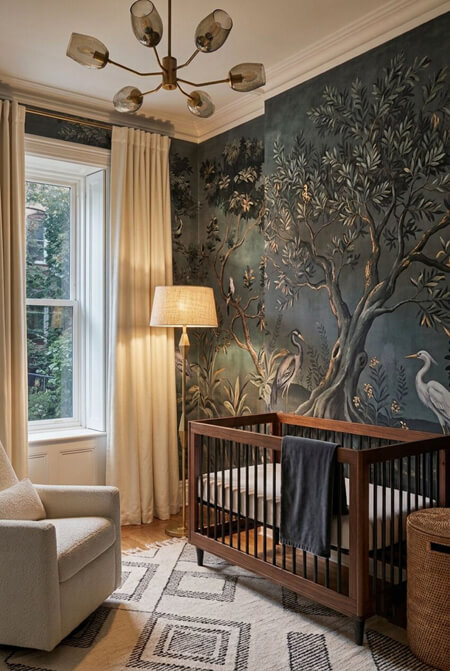 Moody romantic neutral garden themed baby nursery - AI-assisted image | Human-editedNon-Baby Items
One of the fastest ways to elevate a nursery from "baby room" to "designer room" is to include pieces that weren't made for a nursery at all.
Add texture with a woven wicker basket instead of a plastic bin. Use a vintage dresser as your changing table rather than a piece marketed specifically for babies; just make sure it's sturdy enough to hold a changing pad securely, ideally with the pad strapped down. Swap the standard glider for a modern lounge chair in a fabric you actually love.
Keep in mind that your baby won't be a baby for long, so look for ways to repurpose adult furniture that will still make sense in the room five years from now. An antique armoire can replace a nursery-specific wardrobe. A striking light fixture, rather than a baby-themed mobile, adds visual interest overhead without locking the room into an obviously "nursery" look.
The goal is a room that feels like it belongs in the rest of your home, not one that looks like it was pulled entirely from a baby catalog.